Detective work: R.J. Doerr spots restoration clues

Since beginning to examine the house for “footprints” and signs of what The John Updike Childhood Home looked like prior to 1945—when the Updikes left the house at 117 Philadelphia Ave. to move to the Plowville farmhouse—historic restoration expert R.J. Doerr has been uncovering clue after clue, using as starting points interviews the society conducted with classmates and members of the Hunter family, excerpts from Updike’s writing, photos provided by David Updike, and his own research and expertise.

In his short story “The Black Room,” John Updike wrote,

“Outside the guest-bedroom door, the upstairs hall, having narrowly sneaked past his grandparents’ bedroom door, broadened to be almost a room, with a window all its own and a geranium on the sill . . . . Curtains of dotted swiss” and a “rug of braided rags.” In this space sat a large wooden chest: “It was big enough for him to lie in, but he had never dared try. It was painted brown, but in such a way that the wood grain showed through” with hinges “small and black, and there was a keyhole that had no key.”

Updike further wrote, “The guest bedroom [front bedroom], where his mother would go for her naps when she needed to get away from them all, and where [young Updike], when sick, would recline in a litter of picture books and cough-drop boxes, had been expanded outward, into a massive master bedroom, swallowing the hall window, whose sill had always held a potted geranium. At the back of the house, other walls had vanished as his little room with its stained and varnished wainscoting had been merged with the mysterious one [the “black room”] next to it.

columnardividerOn August 12, Doerr and his team of sleuths found filled nail holes and other evidence of where an upstairs front bedroom wall had been before the Hunters knocked it down to create that master bedroom. He also found physical evidence to prove that the existing wainscoting in Updike’s bedroom was not original, except for the exterior wall on Shilling Street. Later Doerr found evidence of why the black room was called that: “There are small fragments of black foil paper that are stapled to the ceiling in the rear room section only. It was a layer that was directly under whatever layer was removed from that ceiling. There are still some small fragments on the ceiling, but it was only held in place with staples, so it came down with the covering. I saved some fragments as well as leaving the small amount that are still adhered to the ceiling,” Doerr said.

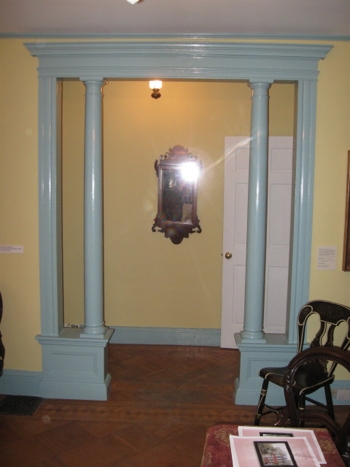
By carefully removing finishes Doerr and Co. were able to expose the original dimensions of the downstairs arches and door openings. They also located an original strip of wainscoting in the dining room so that they can restore that exactly as it was, and they removed the dining room cupboard/cabinet so that the original door opening could be reinstalled. Using “selective paint removal” in the dining room they were able to conclude with certainty that the wood in the dining room was a grain painted finish. By measuring the footprint for the divider between the parlor and living room, they were able to identify the type of columnar divider that was original to the house and remained so during Updike’s time there. This type of divider is consistent with what Updike classmates and the Hunter family recalled, and also consistent with the type of dividers used for houses in the area in 1884, when the house was built.

Pictured is the type of columnar room divider that Doerr is fairly certain was original to the Updike parlor/living room. Work on Phase 1 of the restoration is expected to be completed by the end of summer 2016.

Donate

Posted in Restoration news | Leave a comment

Museum acquires Clint Shilling sideboard-buffet

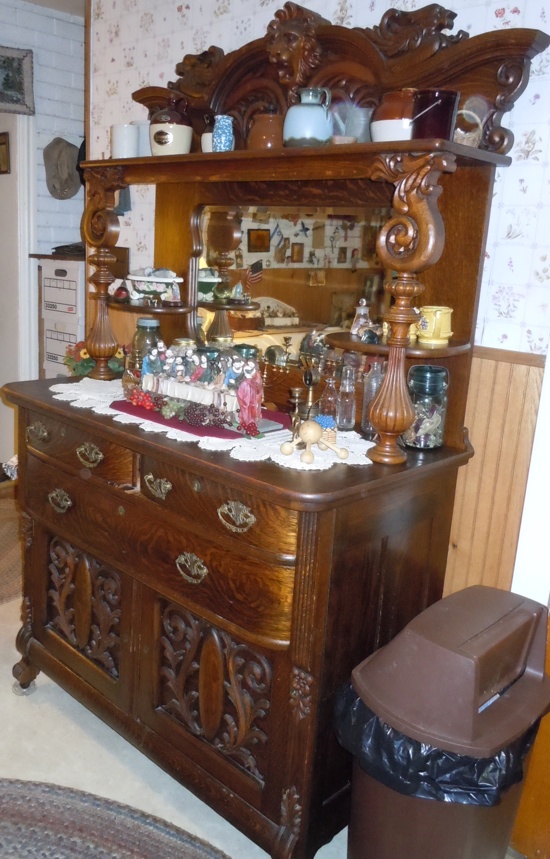
The John Updike Childhood Home recently acquired a sideboard that was owned by Clint Shilling (b. 12 January 1885, d. 10 September 1979) , a local artist who lived at 110 Philadelphia Ave., directly across the street from the Updikes, and who gave young John his first art lessons.  It will be displayed in the dining room against the wall where the Updikes’ less detailed sideboard once stood.

ClintShillingSideboard

The piece came from neighbor Dorothy Huber, a friend of Clint Shilling’s. The grandson of Shillington founder Samuel Shilling, Clint was internationally known as a scenic painter for theater and ballet productions, with restoration another area of specialization—a skill he practiced for many years as artistic director of the Reading Public Museum.

In 1938, when John Updike was five years old, his mother, Linda Updike, arranged art lessons with Shilling. The precocious young Updike would have appreciated the lion’s head carved sideboard that was much more ornate than his own family’s—especially since, according to childhood friend Harlan Boyer, a favorite pastime of the two boys was lining up dominoes on the Updike sideboard and then knocking them down. It is not known how long Updike took art lessons from Shilling, but he was important enough for Updike to mention him by name in his long poem, “Midpoint”:

“Clint Shilling’s drawing lessons: in
the sun he posed an egg on paper, and
said a rainbow ran along the shadow’s rim-

the rainbow at the edge of the shadow of the egg.
My kindergarten eyes were sorely strained
to see it there. My still-soft head

began to ache, but docilely I feigned
the purple ghosts of green in clumsy wax:
thus was I early trained

and wonder, now, if Clint were orthodox.
He lived above a spikestone-studded wall
and honed his mustache like a tiny ax

and walked a brace of collies down our alley
in Pennsylvania dusk
beside his melodic wife, white-haired and tall.”
-“Midpoint” (1968)

The John Updike Society is grateful to Dorothy Huber for enabling us add a piece of furniture that has connections to Updike and the neighborhood. The acquisition of the Shilling sideboard is in keeping with our mission:  The John Updike Society is dedicated to awakening and sustaining reader interest in the literature and life of John Updike, promoting literature written by Updike, fostering and encouraging critical responses to Updike’s literary works, and, through The John Updike Childhood Home, preserving the history and telling the story of John Updike’s relationship with Shillington, Pa. and the influence that Berks County had on his literary works.

For a non-inclusive list of items the society is hoping to acquire, see our page on how to donate.

Posted in Acquisitions | Leave a comment

R.J. Doerr Co. tabbed for historic restoration

Screen-Shot-2014-08-07-at-7.00.33-AMThe John Updike Society board has approved the hiring of R.J. Doerr Co., an Easton, Pennsylvania-based contractor that specializes in historic restorations and home museums. As the Reading Eagle reported, Doerr has “a 25-year history of restoring historic properties for nonprofits, including the home of George Taylor, a signer of the Declaration of Independence.”

On Thursday, July 16, Robert Doerr did a walk-through with society president James Plath at The John Updike Childhood Home at 117 Philadelphia Ave. in Shillington, and the two agreed to a three-phase restoration.

Phase 1, which is projected to be completed by the end of summer 2016, will include all the rooms that have been “deconstructed”—the dining room, living room, parlor, foyer, and all upstairs bedrooms. During this phase, the entire house needs to be rewired and the radiators need to be removed so that a more archivally-friendly forced air system of heating and cooling can be installed.

Phase 2 will include the restoration of the front, side, and second-floor porches.

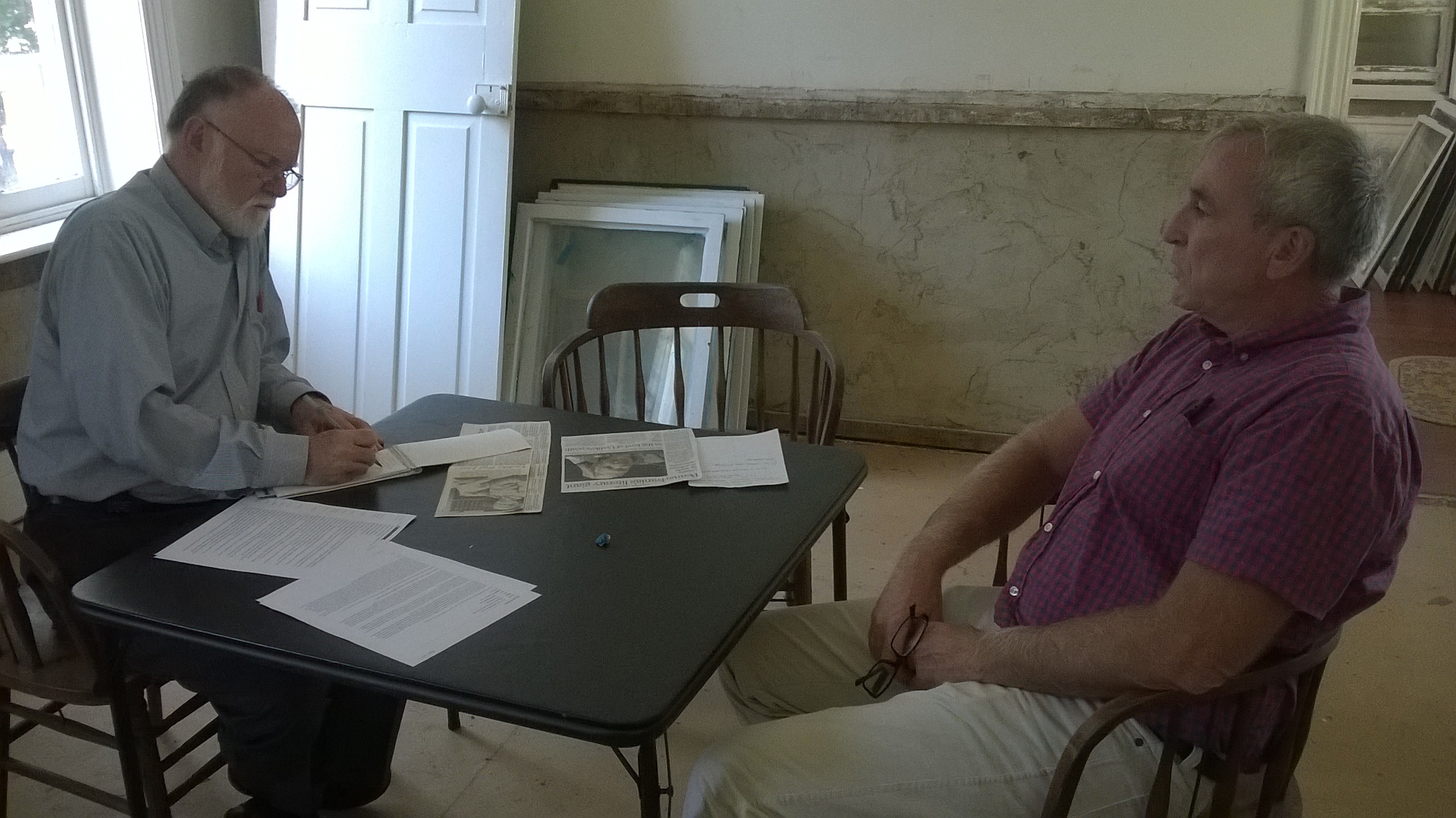
Phase 3 involves the addition of a grape arbor that was there prior to 1945 when the Updikes moved to Plowville, and the addition of decorative exterior corbels that had been removed to make repainting cheaper/easier. The kitchen and second-floor bathroom will also be upgraded to be period, but functional, during this phase. Below Reading Eagle reporter Bruce Posten (l) questions Robert Doerr for the article as they sit in the “deconstructed” dining room.Windows Phone_20150716_014

The total for the three-phase restoration is expected to be around $300,00 to $350,000, and Plath said he is “currently and always” looking for additional corporate, foundation and individual benefactors. Those who donate $1000 or more of cash or in-kind contributions will have their names on a donor wall inside the house.

Work will begin the end of summer, after Habitat for Humanity of Berks County finishes “tear-out.” Plath estimates that Habitat volunteers saved the society $20-30,000 by scraping wallpaper and removing everything that was added to the house after 1945.

The Reading Eagle has the story; our Facebook page has a contractor’s view walk-through video.

Posted in Restoration news | Leave a comment